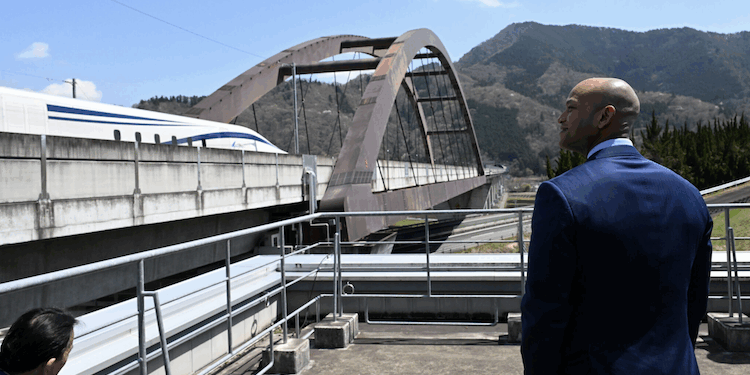
The federal government rejected the idea, so no high-speed train will be speeding through areas of Maryland.
The projected Baltimore-Washington Superconducting Magnetic Levitation rail line, or maglev, would have required a multibillion-dollar investment to build, but the Federal Railroad Administration has concluded that this is no longer possible.
Fort George G. Meade in Anne Arundel County is one of several federal facilities along the route between Washington, D.C., and Baltimore that would have been impacted, according to a notice that will be published in the Federal Register on Monday.
According to the notice, the railroad administration concluded after considerable consultation with these agencies that the direct impacts would have a significant negative impact on agency operations or on significant resources under the control of federal agencies. Furthermore, indirect repercussions would seriously hinder existing agency missions as well as vital operations and infrastructure.
The notice stated that the Baltimore-Washington project was not the one to advance maglev technology, but it did not rule out its future use in the United States. The project’s estimated capital cost, as determined by the U.S. Department of Transportation, is close to $20 billion.